Types of Pranayama Explained for Beginners and Practitioners
Breath serves as the connection point between physical existence and mental existence. The practice of yoga considers breath to be more than a physical function because it represents prana which serves as the vital energy that permeates all body cells. Mastering breath control allows you to gain command over your energy levels and emotional states and your ability to focus.
In this guide, we’ll look at the types of pranayama, how they function, and how they are useful for the beginner as well as the advanced practitioner. There are many different types of pranayama and if you have ever asked how many types of pranayama are there or what are some types of pranayama and its benefits, then this comprehensive guide will help you get clarity and confidence.
What Is Pranayama?
The term pranayama derives from two Sanskrit roots which combine to create its meaning.
- Prana refers to the vital energy which sustains life.
- Ayama defines two specific concepts which include both control and expansion.
In classical yoga texts like the Yoga Sutras of Patanjali, pranayama is the fourth practice of Ashtanga Yoga which comes after asana practice and helps the yogi advance to meditation.
Pranayama requires practitioners to breathe through controlling their breathing process which includes handling both inhalation and exhalation and maintaining breath control through Kumbhaka. The practice leads to enhanced lung capacity and improved focus and emotional stability and greater spiritual understanding.
How Many Types of Pranayama Are There?
Yogic texts describe various traditional pranayama practices which have been established throughout history. Modern yoga teachings currently present approximately 8 to 12 fundamental pranayama techniques to their students.
The answer to your question about how many pranayama types exist depends on which classification system you choose. Beginner students need to study between five and eight basic techniques which will help them establish their fundamental skills.
We will examine all the various pranayama techniques which exist in their complete form.
1. Nadi Shodhana (Alternate Nostril Breathing)
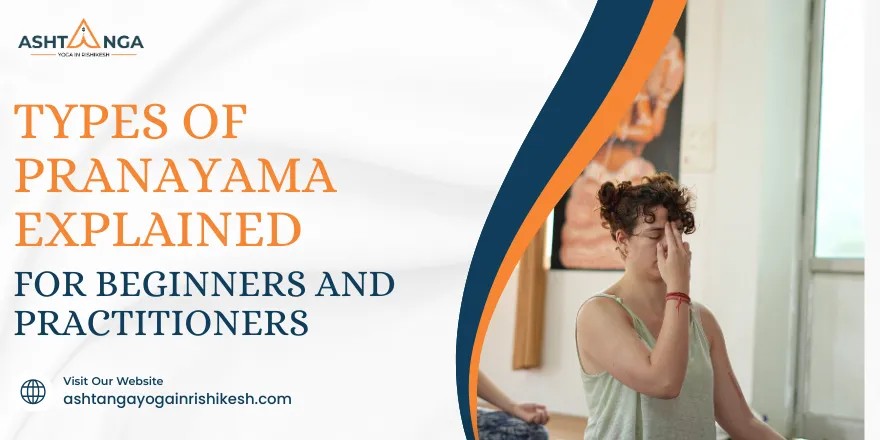
The term Nadi Shodhana describes the process of energy channel cleansing. The practice serves as a vital pranayama technique which establishes equilibrium within the nervous system.
How to Practice:
- The practitioner should sit in a cross-legged position which provides comfortable seating.
- The right thumb must be used to block the right nostril.
- The practitioner should breathe in through the left nostril.
- The left nostril must be closed while the practitioner exhales through the right nostril.
- The process should be repeated in alternating fashion.
Types of Pranayama and benefits (Nadi Shodhana):
- Balances left and right brain Hemispheres
- Relieves stress and anxiety
- Enhances focus
- Readies the mind for meditation
This is especially good to recommend to beginners as it is a gentle but powerful practice.
2. Kapalbhati Pranayama (Skull Shining Breath)
Although Kapalbhati functions as a Shatkarma cleansing practice it appears in various forms of pranayama.
How to Practice:
- The practitioner should maintain a straight sitting position.
- The practitioner should take a deep breath.
- The practitioner needs to exhale forcefully by using abdominal muscles.
- The process of inhalation occurs without active efforts.
Types of Pranayama and Its Advantages (Kapalbhati):
- Cleans out Lungs with Kapalbhati Hathapradipika:
- Improves digestion
- Enhances metabolism
- Rises energy levels
Beginners are advised to practise slowly and not to over exert themselves. If you suffer from high blood pressure or are pregnant then seek advice from a teacher.
3. Bhastrika Pranayama (Bellows Breath)
Bhastrika consists of strong inhalation followed by strong exhalation and it is said that the whole body becomes active.
How to Do:
- Sit upright.
- Inhale deeply and forcefully.
- Exhale with force.
- Keep the rhythm even.
Types of Pranayama and its benefits:
- Enhances breath capacity
- Eliminate toxins
- Increases oxygenation
- Generates heat from within
It is for a teacher who has taught before.
4. Ujjayi Pranayama (Victorious Breath)
Ashtanga Yoga practitioners use Ujjayi breathing to produce a gentle sound that resembles ocean waves through their throats.
How to Practice:
- The practitioner needs to produce a small throat obstruction.
- The practitioner needs to perform slow breathing through their nose.
- The person needs to create a steady breathing pattern.
Types of Pranayama and Its Benefits:
- The practice improves concentration which helps with asana execution.
- The process helps to control body heat.
- The process helps to reduce nervous system activity.
- The process helps to develop stamina.
Ujjayi serves as a necessary practice for people who study dynamic yoga methods.
5. Anulom Vilom
Anulom Vilom is a slightly modified practice of Nadi Shodhana that is usually done without holding the breath.
Benefits:
- Helps in better functioning of the lungs
- Decreases stress
- Promotes a healthy heartbeat
- Improves mental clarity
For the readers who are wondering what are different kinds of pranayama, I believe this is one of the most safest choices for beginners.
6. Sheetali Pranayama (Cooling Breath)
Sheetali gives your body and mind a cooling effect.
How to Practice:
- Roll the tongue into a tube.
- Inhale through the rolled tongue.
- Exhale through the nose.
Types of Pranayama and Benefits:
- The technique decreases body temperature
- The method helps to control both anger and irritation
- The method aids in digestion
- The technique provides relief in hot weather
The method works best after intense asana practice or during summer.
7. Sheetkari Pranayama
Identical to Sheetali however the breath is drawn through the teeth through more like an inhalation through an exhalation.
Benefits:
- Relieves tension
- Decreases the body heat
- Regulates hunger and thirst
- Encourages calmness
8. Bhramari Pranayama (Bee Breath)
Bhramari consists in making a humming sound like that of a bee.
How to Practice:
- Close your ears with your fingers gently.
- Breathe all the way in.
- Exhale with a humming sound.
Types of Pranayama and its Benefits are:
- Decreases stress
- Better Sleep Patterns
- Improves focus
- Eases headaches
Fantastic for your emotional equilibrium.
How Beginners Should Start
If you are a beginner in yoga:
- Start with Anulom Vilom or Nadi Shodhana.
- Train for 5-10 minutes a day.
- In a straight-backed, comfortable seat, do the katakasana.
- Don’t breathe forcefully in the beginning.
- Study under a guide, if you can.
Organized courses such as 100 hour yoga teacher training rishikesh can provide you a profound as well as safe understanding of breathwork. Just a brief yoga retreat rishikesh experience will have you engaging in the practice of pranayama in the tranquility of the Himalayan scenery.
Final Thoughts
Understanding the types of pranayama requires more than learning techniques because it teaches you how breath affects your emotional state.
The practice of pranayama provides through its various techniques a continuous path of development for both novice practitioners and expert yogis who seek to master their skills.
Begin your activities at a slow pace. Maintain your current speed. Practice controlled breathing techniques.
Through consistent practice you will achieve the following improvements
- Your thinking abilities will become more precise
- Your emotional states will achieve equilibrium
- Your energy levels will experience a boost
- Your meditation practice will reach deeper levels
The breath exists as your constant companion. Your ability to direct your breathing establishes your control over your existence.