
What are the five elements of yoga philosophy?
Earth, Water, Fire, Air and Space are the five elements of the yogic philosophy. In yoga, these are known as the five Mahabhutas (elements): Ether, Air, Fire, Water and Earth. In yoga, all things in nature are derived from these five and you are no exception. The meanings of each element, yoga poses that embody it and how to know which one is the missing element are listed below.
The Five Elements of Yoga at a Glance
Here is a quick look at each element and what it stands for:
- Earth (Prithvi): Linked with the root chakra and the sense of smell. It's a sense of stability and grounding.
- Water (Jala): Linked with the sacral chakra and the sense of taste. It represents adaptability, flexibility and fluidity.
- Fire (Agni): Linked with the solar plexus chakra and the sense of sight. It means energy, determination and change.
- Air (Vayu): Related to Heart chakra and the touch sense of the body. It symbolizes activity, air and levitating.
- Space (Akasha): Linked with the throat chakra and the sense of hearing. Open heart and tranquility of the mind.
What is Pancha Mahabhuta?
“Pancha” means five, “maha” means great, and “bhuta” means element. The concept was taken from Yoga and Ayurveda, ancient Indian medical doctrine. An old method of self understanding. It is not a medical test, use only for awareness and balance.
The Five Elements in Yoga, Explained
Earth (Prithvi): The Element of Stability
- It feels like: Strong, calm, and grounded.
- Low earth may feel like: Restless, scattered, or unable to settle.
- Try: Mountain pose, Warrior poses, and Child’s pose.
Earth is the lumpen element, the slowest and the heaviest one with the greatest atomic mass. Its associated chakra is the root and it is associated with the sense of smell.
Water (Jala): The Element of Flow
- It tastes like: Soft and flexible with an easy feel.
- Low water may feel like: Stiff, stuck, or hard to adapt to change.
- Try: Cat-Cow, hip openers, and slow vinyasa flow.
Water adapts itself to the shape that it is placed in. It is the flexibility in body and mind that are the two meanings of it in Yoga.
Fire (Agni): The Element of Energy
- It feels like: Motivated, bold, and clear-headed.
- Low fire may feel like: Tired, slow, and low on drive.
- Try: Sun Salutations, Boat pose, and Kapalbhati.
Fire has a lot to do with changing and heating up. In Ayurveda, it is associated with the metabolism, determination and valor in yoga.
Air (Vayu): The Element of Movement
- It feels like: Light, free, and easy to breathe.
- Too much air may feel like: Racing thoughts and a jumpy mind.
- Try: Slow pranayama, Cobra pose, and gentle backbends.
You're able to hear the air in your breathing and pulse. It is associated with the chakra chakra which corresponds to the heart chakra and the sense of 'touch'.
Space (Akasha): The Element of Openness
- It feels like: Quiet, spacious, and peaceful.
- Low space may feel like: Crowded, cramped, or mentally noisy.
- Try: Savasana, meditation, and Om chanting.
The most subtle and all others are contained within Space.
Which Element Do You Need More Of? A Quick Self-Check
In the traditional side, the connection to how you feel, is a way to give the element to investigate a cue:
- Feeling scattered or restless? Focus on Earth. Try Mountain pose for 2 minutes.
- Feeling stiff or stuck? Focus on Water. Try 10 rounds of Cat-Cow.
- Feeling tired and unmotivated? Focus on Fire. Try 3 Sun Salutations.
- Feeling anxious or overthinking? Focus on Air. Try slow nose breathing for 5 minutes.
- Feeling mentally crowded? Focus on Space. Try Savasana for 5 minutes.
This is a simple guide and not a diagnosis. If tiredness or worry lasts for a long time, please talk to a doctor.
Five Elements and Chakras
Every element rests on a chakra, an energy center in yogic philosophy. The earth relates to the root chakra, Water to the sacral, Fire to the solar plexus, Air to the heart, and Space to the throat. This is why chakra-based yoga often uses the elements in its poses and meditations.
Five Elements and Hand Mudras
Yoga also connects the elements with your five fingers:
- Thumb: Fire
- Index finger: Air
- Middle finger: Space
- Ring finger: Earth
- Little finger: Water
Mudra involves touching the fingertips together when sitting, breathing slowly. Do this: touch index finger with thumb and breathe slowly for 2 minutes.
Five Elements and the Layers of the Body
Yoga does not treat body as “feet and fingers”. It witnesses layers starting from the body to the breath, mind and deeper awareness. These are called koshas. Read our guide on how many koshas we have according to yogic philosophy to see how the elements connect to each layer.
A 15-Minute Practice to Balance the Five Elements
Do this once a day. 3 min per step:
- Earth: Stand in Mountain pose and press your feet into the floor.
- Water: Do Cat-Cow and slow hip circles.
- Fire: Practice 2 or 3 Sun Salutations.
- Air: Sit and breathe slowly through the nose.
- Space: Lie in Savasana and let your mind go quiet.
Pay attention to the difficulty level of the step that you notice. This is typically the part to devote more of your time. To learn the basics behind each of yoga's practices, check out the main elements of yoga.
Learn the five elements in Rishikesh.
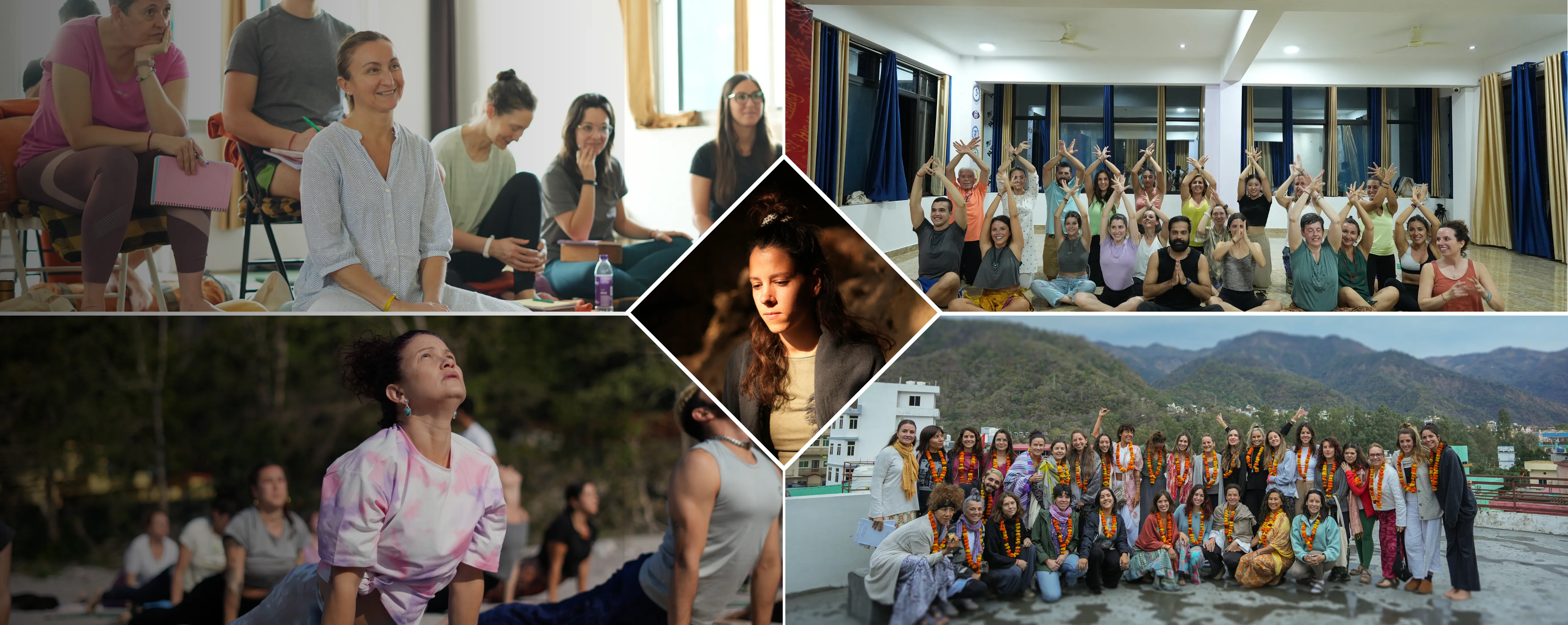
To have the elements of earth (mountain), water (ganga), fire (morning sun), air (fresh breeze) and space (bluest sky) in reality, Rishikesh is a great city to enjoy. Thanks to these teachers who have been practicing here, it will be easier to feel, understand and practice the ideas. At Ashtanga Yoga in Rishikesh, our teachers explain yoga philosophy in simple words, so every student can follow.
Final Thoughts
The five elements provide you with a basic plan for your practice. See how you feel, select the element it matches, and select the pose or breath it matches. It takes just a few minutes a day to get started.